Trieste Airport to Cruise Port: Transfer & Transport Guide
Compare the train, bus, taxi and private transfer from Trieste Airport to the cruise port, with walking routes, luggage trade-offs and sensible buffers.
On this page
Trieste rewards passengers who treat the airport run as part of the port day rather than an afterthought. The airport lies inland at Ronchi dei Legionari, the ships berth along the city waterfront, and the connection between them is a short regional journey followed by a last mile you can walk or ride.
The choice comes down to luggage volume and your all-aboard time. A solo traveler with a rollaboard can ride the train and walk the seafront; a family with four suitcases and a 4 p.m. departure is better served by a door-to-door vehicle or the cruise line's own transfer coach. The same trade-offs between rail, coach and private car shape the FCO Airport to Civitavecchia Cruise Port options if you are comparing Italian turnaround ports.
What the airport-to-port run involves
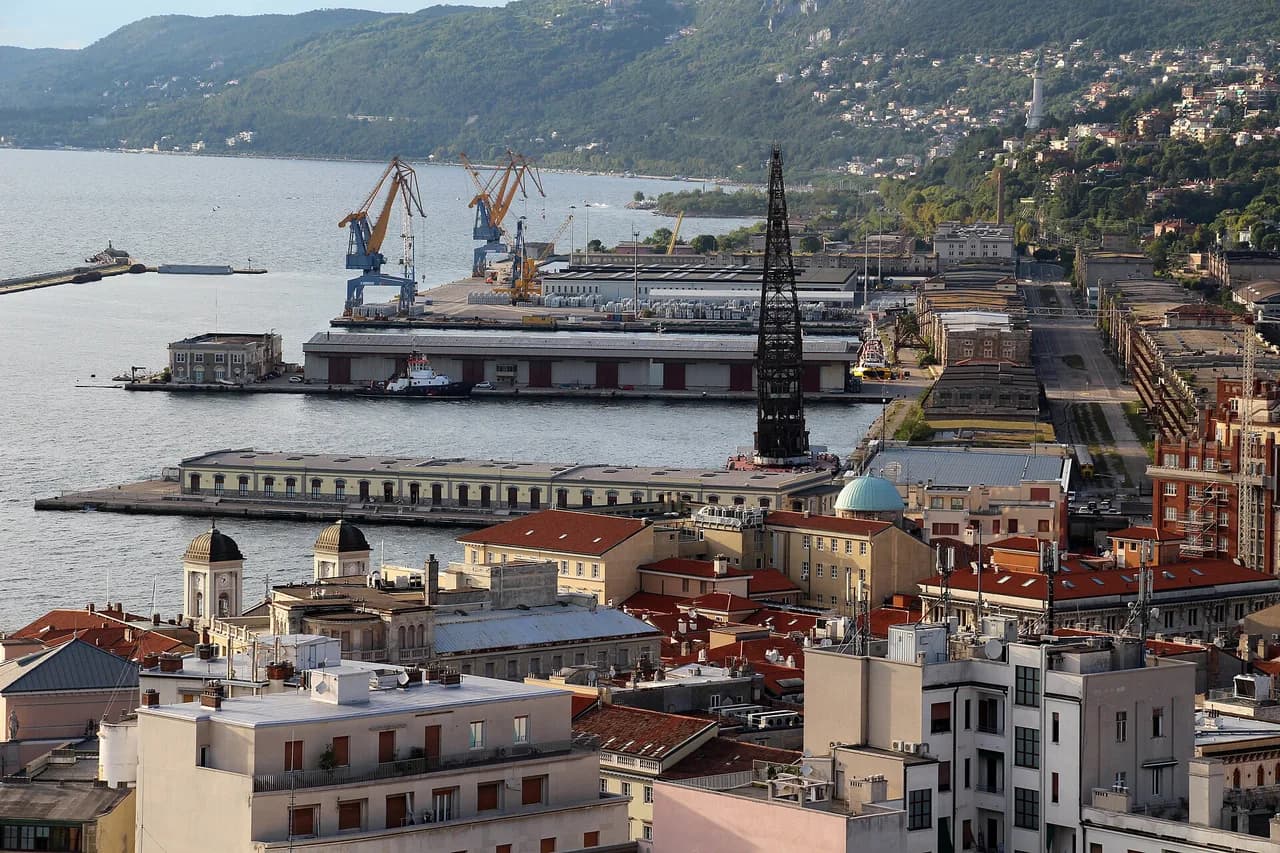
Trieste Airport (TRS) is not a city-center airport: it sits at Ronchi dei Legionari, and arriving passengers reach Trieste by rail or road. The cruise berths are in town along the waterfront, close to the Stazione Marittima building that anchors the port area.
The last mile depends on which berth your ship is assigned. Berths closer to the Stazione Marittima put you a short walk from the station side of town, while berths further along the moles add distance with luggage. Your cruise line's travel documents name the terminal, and the port authority publishes berth assignments, so match that to the map before you decide between walking and a taxi.
The train from Trieste Airport
The airport has its own station on the Ronchi line, with Trenitalia regional trains running toward Trieste Central. It is the most predictable option in bad traffic because the rails bypass the road network entirely, and the station sits within walking distance of the terminal building at Ronchi.
Buy your ticket at the airport station before boarding and validate it where Trenitalia requires it; on regional services in this region, ticket machines and the Trenitalia app are the usual channels. Keep bags with you rather than relying on luggage racks in a crowded carriage, and allow time to find the right platform if you are swapping from a flight.
The journey ends at Trieste Central, not at the quay. From there the port is a walk along the seafront, which one cruiser describes as roughly fifteen minutes on foot to the ship, so the train works best for travelers with manageable luggage and a comfortable time margin.
Bus and coach options
Road-based services from the airport drop passengers in the city rather than at the gangway, which means you still complete the final leg on foot or by taxi. Where you are set down matters: a stop near the station end of town shortens the waterfront walk, while a drop further from the port adds a taxi ride with bags.
Treat the coach as a budget-friendly option for a cruise call or a pre-cruise night in a city hotel rather than as a direct port service. If your ship sails the same day, the coach's dependence on road traffic is the deciding trade-off against the train.
Taxi and private transfer
A taxi from the arrivals rank is the simplest door-to-door solution: the driver takes you and your luggage directly to the berth your ship uses, with no walk along the waterfront at the end. For two or more passengers with heavy bags, the convenience often justifies the higher fare compared with the train.
Pre-booked private transfers work on the same logic but add a confirmed pickup and a driver who tracks your flight. That matters if your flight lands late in the day with an evening all-aboard, when a taxi queue at a small airport can eat the buffer you built.
Ask the driver to confirm the berth or terminal name on the booking rather than just "the port", because Trieste's quays stretch along the waterfront and the wrong drop-off means hauling suitcases back along the moles.
Shared shuttles and pre-booked rideshares
Shared shuttle platforms such as GoOpti pair passengers heading the same way, offering lower fares in exchange for fixed departure windows and possible stops. GoOpti states that greater flexibility and earlier booking tend to secure a better price, so a transfer booked weeks ahead usually beats one arranged on arrival.
The trade-off is rigidity. GoOpti sends the exact departure time by SMS and email the day before travel, and a shared driver cannot wait for late passengers because other travelers are on board, so the service suits passengers with a comfortable margin rather than a tight embarkation.
Extra luggage must be added and paid for at booking: one piece of hand luggage up to 5 kg is free, and additional pieces are charged per piece and direction, from €1 for up to 10 kg and €3 for up to 20 kg. Add bags when you reserve rather than at the kerb.
The arrangement is only worth considering for this route if the platform lists Trieste Airport pickups for your date. Confirm the pickup point in the app before travel, since airport and city-center meeting points differ.
Driving yourself and parking at the port
Passengers starting or ending a cruise in Trieste can drive to the port, but parking near the waterfront is limited and the practical choice is between an official port-area car park and an off-site garage with a shuttle. Compare the rate for the full length of your cruise, not the nightly rate, and book ahead if you sail in high season.
Drop your passengers and luggage at the terminal first, then park, so the group is not manoeuvring cases through a car park. Check current details with the port or your car park on whether parking is inside the port zone or requires a transfer back to the terminal.
Arriving from Venice instead
Some passengers fly into Venice Marco Polo and connect to Trieste by train via Venice Mestre, which has a good rail service onward to Trieste Central before the waterfront walk to the ship. This routing suits travelers who find better flights into Venice, but it adds a change of trains and a longer day with luggage.
If your cruise begins in Venice rather than Trieste, the logistics invert and the port transfer runs toward the Venice terminals; the same planning rules apply, with more distance and more traffic exposure.
From Trieste Central station to the berths
Trains arrive at Trieste Central on the edge of the old town, and the route to the port runs along the seafront past the Stazione Marittima building. Staying on the seaward side of the streets keeps you oriented: the water and the moles should stay on your right as you head toward the ship.
With rolling luggage the walk is fine in dry weather but slow in rain or heat, so a short taxi from the station forecourt is a reasonable fallback. The full walk from station to berth is covered in more detail in the port-to-station notes, including which exits to use.
Matching the transfer to your call
Embarkation and disembarkation days are turnarounds: you have hours, not a fixed all-aboard, and the main risk is a delayed flight rather than a missed sailing. In that situation the cruise line's transfer coach absorbs much of the stress, because the line tracks its own arrivals and handles the bags from coach to ship.
A same-day port call is different: the ship arrives in the morning and leaves on schedule, so airport transfers are rarely relevant unless you are joining or leaving mid-cruise, and the transfer you need is berth to city, not berth to airport.
If you stay overnight before the cruise, choose a hotel near the waterfront and you remove the airport-to-port leg on sailing morning.
How much time to build in
On embarkation day, work backward from the check-in deadline rather than the sailing time, since boarding closes earlier. Allow time for the train ride from Ronchi, the waterfront walk or taxi, and bag drop at the terminal, plus a margin for a delayed flight.
Book a flight that lands with daylight to spare if you are taking the train, because the final leg is a walk through town. For late arrivals, pre-book a private transfer or use the ship's coach so the last mile does not depend on your own navigation with luggage.
Ship transfers versus going independently
The cruise line's transfer coach wins on luggage handling and on the line's awareness of your flight, but it usually runs on a fixed schedule and may wait for all passengers on the coach before departing. Independent rail travel is faster for a solo traveler with light bags but leaves you responsible for every connection.
No transfer option guarantees the ship will wait for independent travelers, so on a same-day arrival choose the option with the fewest moving parts. Rail wins over road when traffic is unpredictable; a private car wins over rail when you have several cases and a tight deadline.
Plan Your Port Day
For most passengers, the cleanest plan is a train from Ronchi into Trieste Central followed by the waterfront walk, or a pre-booked car if luggage is heavy or the arrival is late. Match the drop-off to your ship's berth and keep a buffer before check-in closes.
Once ashore, the city itself is compact and walkable, and the seafront route links the station, the Stazione Marittima building and the berths.
Frequently Asked Questions
How do I get from Trieste Airport to the cruise port?
Take a Trenitalia regional train from the airport's Ronchi station to Trieste Central, then walk or take a short taxi ride along the waterfront to your berth. Taxis and pre-booked cars run door-to-door from arrivals to the terminal.
Is there a train from Trieste Airport to the cruise port?
Yes, there is a rail link, but it ends at Trieste Central station rather than at the quay. The final leg is a walk along the seafront toward the ship, or a short taxi ride with luggage.
Can you walk from Trieste train station to the cruise ship?
Yes, the route follows the waterfront past the Stazione Marittima building, and one cruiser describes it as roughly fifteen minutes on foot. Allow longer with heavy suitcases or in wet weather.
What is the closest airport to Trieste Cruise Port?
Trieste Airport at Ronchi dei Legionari is the regional airport serving the city, with rail and road connections into town. Venice Marco Polo is an alternative for travelers who find better flights, but it adds a train change at Venice Mestre.
Should I book a shared shuttle or a taxi?
A shared shuttle suits travelers with flexible timing and light bags, while a taxi or private car is better when you have several suitcases or a tight check-in deadline. Shared drivers cannot wait for late passengers, so leave a margin.
How early should I arrive before my cruise departs?
Work backward from your check-in deadline rather than the sailing time. Allow for the train or road journey, the final walk or taxi and bag drop, plus a buffer in case your flight is delayed.
Sources
Port-day notes for your next cruise
Optional updates to our port guides.
You might also like

Continue reading
More guides you'll find useful