Things to Do in Le Havre on a Cruise Port Day
Plan a Le Havre port day around UNESCO architecture, Saint-Joseph's Church and the waterfront, with realistic timing for Normandy and Paris side trips.
On this page
Le Havre gives you a rare choice on a port day: a compact UNESCO-listed city centre built in concrete after the war, or a long run out to Paris, Honfleur or the Normandy beaches. The city suits passengers who want to walk, look at architecture and be back at the gangway with hours to spare, while the side trips suit anyone treating the call as a once-only chance to reach a famous name. Decide which of those two days you want before you leave the ship, because the distances make it hard to do both.
Why Le Havre suits a port day
The city centre is a UNESCO World Heritage site rebuilt under architect Auguste Perret after wartime bombing, so you are seeing wide boulevards, open squares and carefully planned public spaces rather than medieval lanes. That layout makes it easy to navigate on foot and hard to get genuinely lost. It is also a working industrial harbour, with container ships, cranes and warehouses around the terminal, so the first impression from the ship is not the one you get twenty minutes later.
Paris sits roughly 120 miles to the southeast, which turns a capital day into a long transfer in each direction rather than a stroll. Honfleur lies across the Seine estuary and the D-Day beaches sit along the Normandy coast, both closer than Paris but still dependent on road time. Choose one anchor for the day, then build the rest of your hours around the return journey instead of adding a second destination.
Where ships dock
Cruise ships berth at the port's cruise terminal inside the commercial harbour, with a welcome centre on site offering tourist information, shops, restrooms and free Wi-Fi plus bicycle rental. A taxi rank stands outside the terminal building. The berth is not beside the cafés and marina, so budget time for leaving the secure port area before you reach anything you came to see.
Published walking times vary with where you count the city as starting: allow around 20 minutes just to clear the port area and closer to 50 minutes to reach the centre on foot. The route is flat and straightforward, which makes it viable for most mobile passengers but a poor choice in driving rain or strong wind. Treat the exit walk as a fixed cost of the day, not an optional extra.
Getting into town
Cruise lines commonly run shuttle buses between the terminal and the city centre, with drop-off points near landmarks such as the Le Volcan arts complex and the Espace Coty shopping mall. Schedules and fares are set by each cruise line, so read the sheet handed out at the gangway to see how often the buses run. Taxis wait at the terminal and are the quickest option if you are carrying mobility aids or the weather has turned.
If you go independently, the flat walk out of the port leads toward the waterfront and the container sculpture, which makes a sensible first target. Public transport inside Le Havre includes modern trams and the Funiculaire linking the lower town with the residential heights above. Gare du Havre, the main railway station, sits about 2.2 km from the terminal, roughly a 30-minute walk, and is the departure point for regional trains including services toward Rouen.
A walking loop of the UNESCO city centre
Start at the Catène de Containers, Vincent Ganivet's sculpture of stacked shipping containers bent into two giant arches, which celebrates the port's trade and is one of the closest photo stops to the terminal. Near it you pass the fish market along the quays, where locals buy the day's catch in the morning. Both are quick stops rather than destinations, so they work well as an opening half hour while you get your bearings.
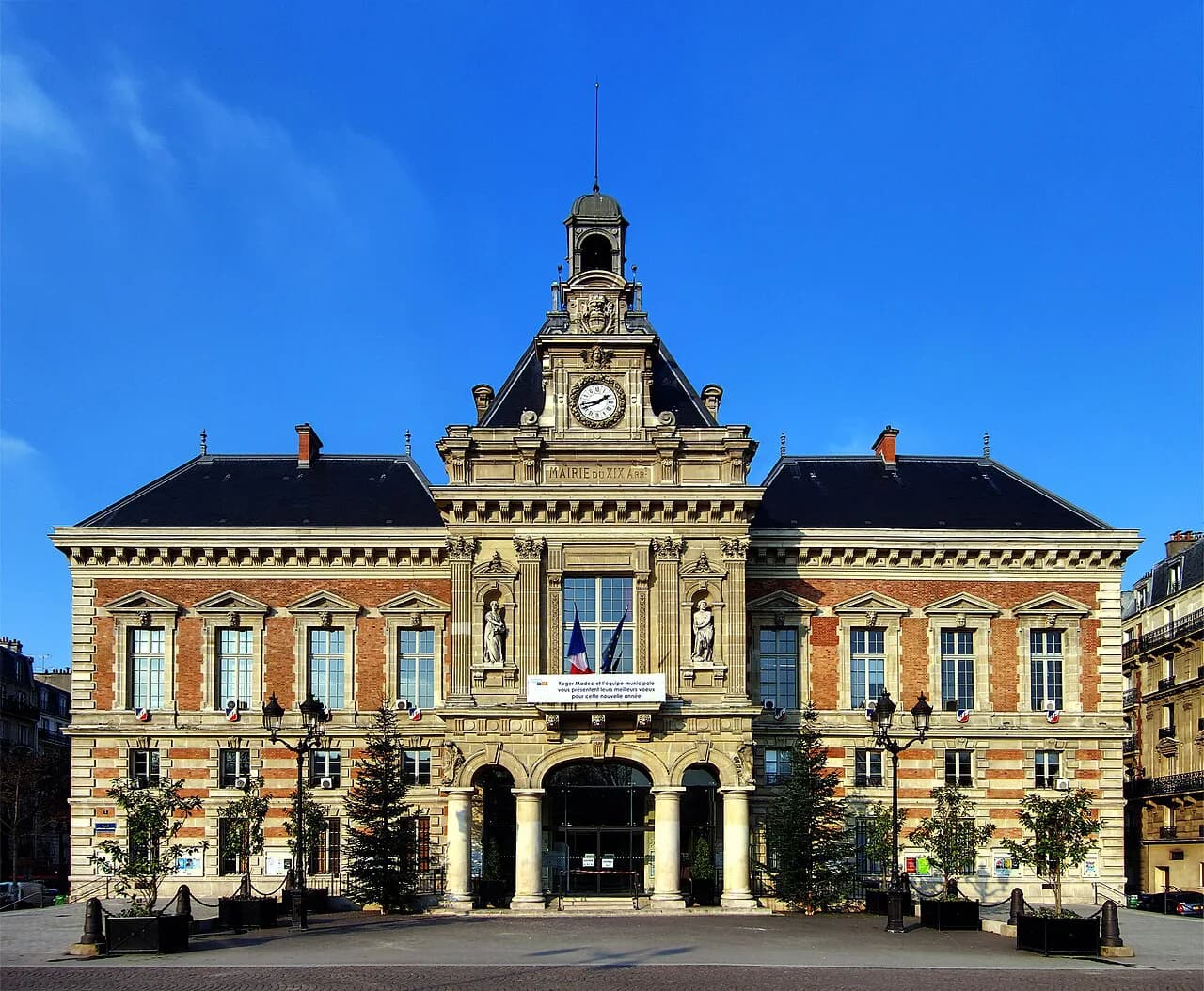
From there, follow rue de Paris into the grid of Perret's reconstruction: the Hôtel de Ville with its square and fountains, the broad shopping streets, and the waterfront promenades above the marina and docks. Allow around 50 minutes on foot from the terminal to the Hôtel de Ville if you walk the whole way. The city hall area doubles as the main transport hub, which makes it a useful place to rejoin a shuttle or pick up a tram.
Saint-Joseph's Church
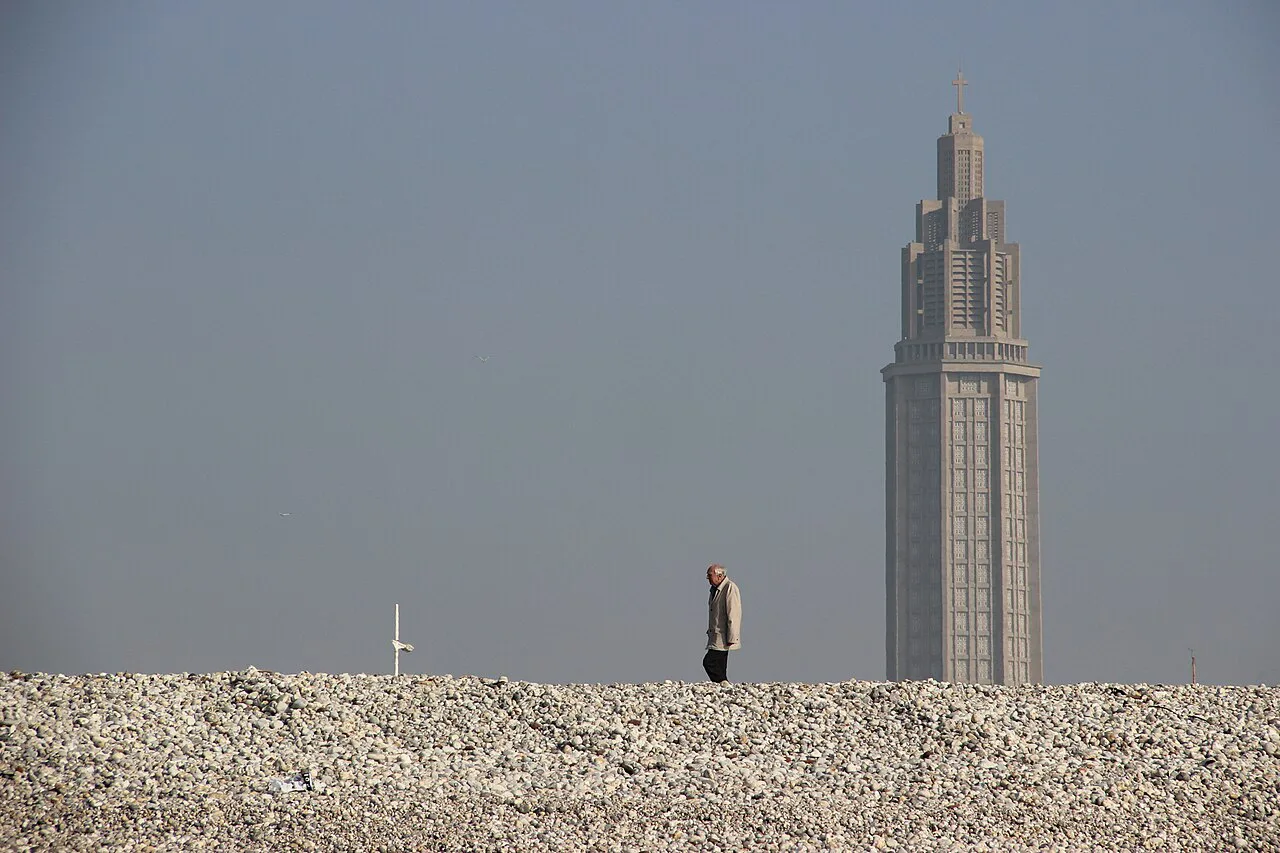
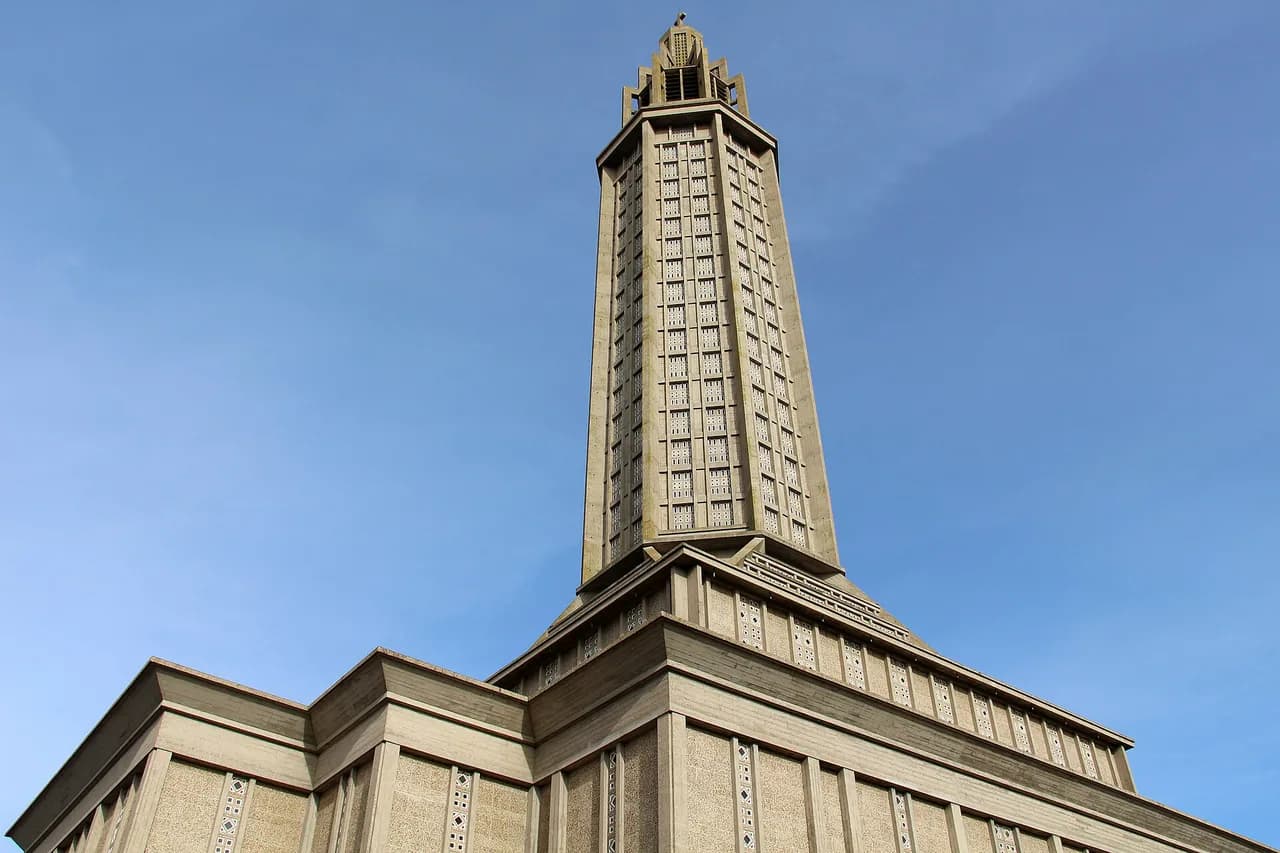
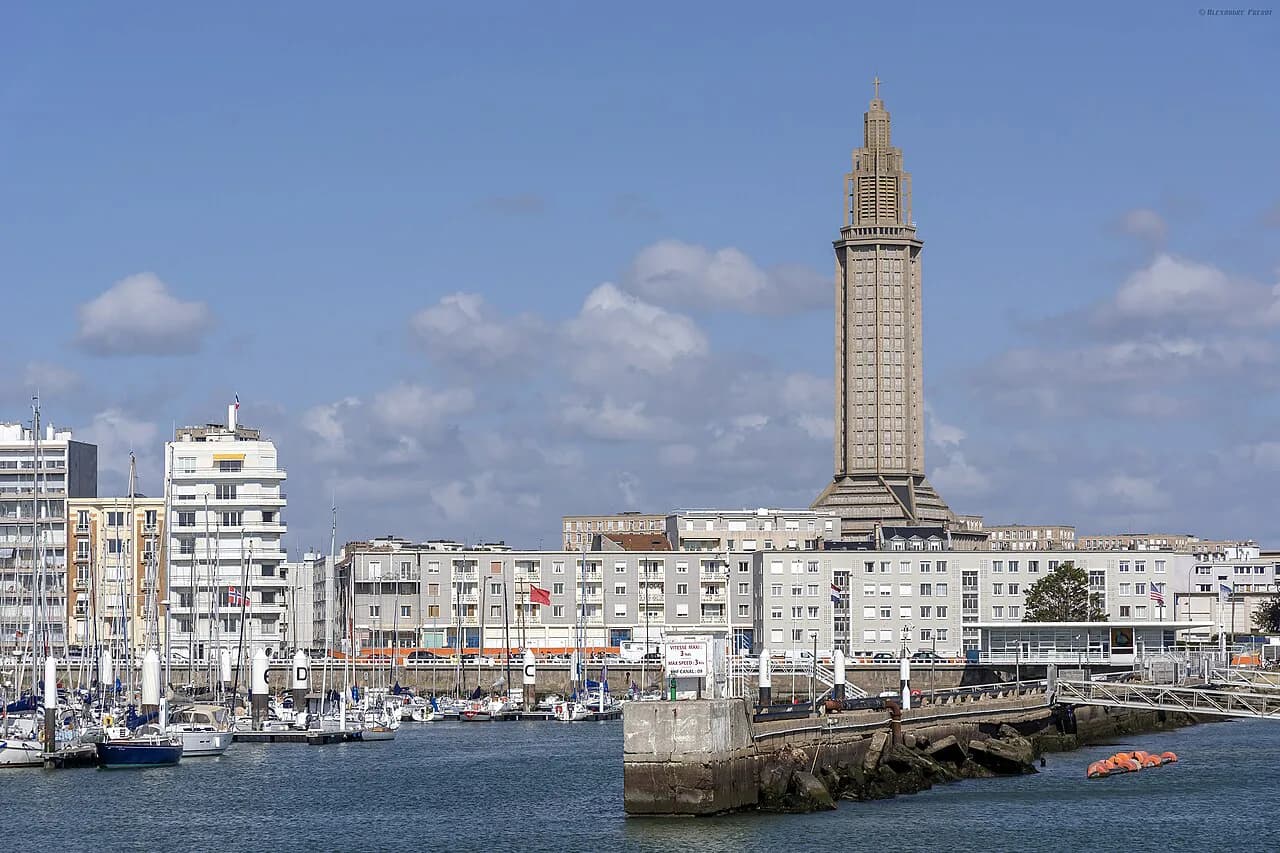
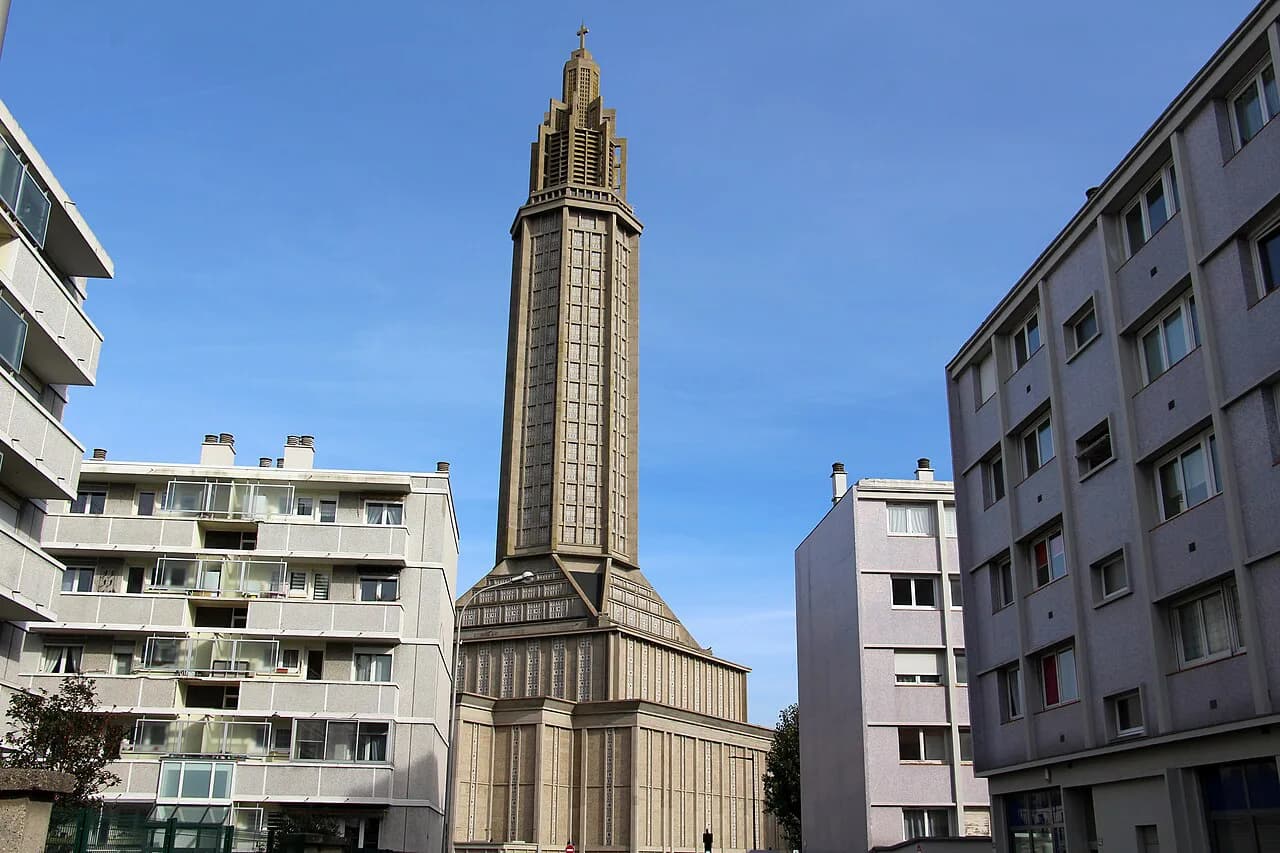
Saint-Joseph's Church is the one sight to prioritise in town. Perret's design, completed in 1957, pairs a plain exposed-concrete exterior with an octagonal tower that rises 107 metres and serves as a landmark for ships entering the port. The tower was conceived as a memorial to those killed in the wartime bombing, and thousands of hand-blown coloured glass panels by Marguerite Huré light the interior.
Entry is free, and 15 to 20 minutes inside covers it comfortably, which makes the church an easy fit even on a short call. It sits about 45 to 50 minutes on foot from the cruise terminal, so pair it with the city centre loop rather than treating it as a separate trip. The tower is visible from much of the city, so you can use it to steer yourself back toward the centre.
Le Volcan and the Perret story
Le Volcan, Oscar Niemeyer's white crater-shaped building, holds a theatre, cultural spaces and a public library, and its curves sit deliberately at odds with Perret's geometry around it. Even from outside it is worth the detour, and it is one of the shuttle drop-off landmarks, so you can combine it with the ride into town. Seeing both architects in one afternoon explains why Le Havre's UNESCO listing is about an idea of urban planning, not about picturesque old streets.
The reconstruction story is what gives the concrete its meaning: after the city was largely destroyed in the Second World War, Perret's team rebuilt it as a showcase of modern urban design, which earned the city centre its World Heritage status. Walking the wide boulevards with that in mind changes a superficially stark city into a coherent piece of planning. If you have limited hours, this is the context worth reading up on before you go ashore.
MuMa and the Impressionist collection
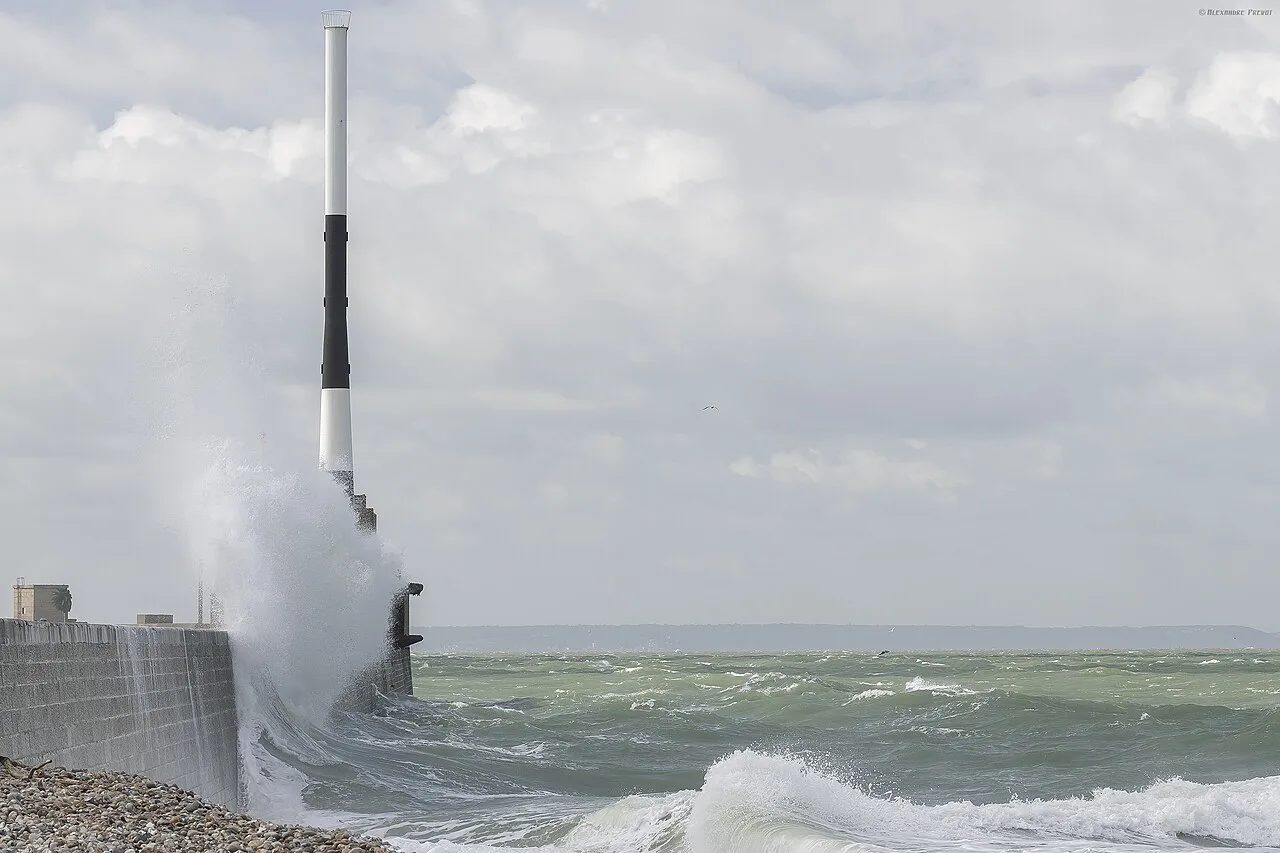
The Musée d'art moderne André Malraux, known as MuMa, sits near the harbour watchtower with a collection spanning the fifteenth to twentieth centuries, including Impressionist works by Monet, Renoir and Degas. Its Impressionist holdings are described as second only to Paris, which makes it the strongest indoor option if rain settles in. The museum closes on Mondays, so a Monday call is a day to plan around architecture and the waterfront instead.
Waterfront and the walk toward Sainte-Adresse
Wide promenades follow the marina, harbour and city centre, giving you views across both leisure boats and commercial shipping, and a modern white pedestrian footbridge over the docks is a good vantage point for photographs. The bridge has a fairly steep incline, so passengers with mobility difficulties may prefer to enjoy the waterfront from the level quays. Continue along the seafront and the beach toward Sainte-Adresse for a breezier, less built-up walk.
The beach at Sainte-Adresse shifts between pebbles and sand with the tide, and the cliffs at the end of the main beach walk give a panoramic view back over the city, the beach and Saint-Joseph's tower. On clear days you can pick out Deauville and Trouville along the coast. This is a fair-weather option: with wind and rain off the Channel, the sheltered city centre loop is the better use of your hours.
Shopping and food in town
Le Havre serves as a retail centre for the wider Normandy region, with pedestrianised streets of international brands, French retailers and department stores, and the Docks Vauban shopping centre sits in its own quarter rather than on the route to the city hall. Les Halles is the market hub, liveliest in the morning, where you can buy cheeses, oysters, charcuterie and crêpes. Note that many shops pause between 1 and 3 p.m., so shop before lunch or after the afternoon restarts.
Sunday is noticeably quieter, with many shops shut and grocery stores typically open until noon, while Monday brings further closures and MuMa is among the museums that stay closed. Normany food worth trying includes cider and Calvados from local orchards, Camembert, and salt-marsh lamb. Pair a market stop with a bakery visit rather than relying on restaurant service during the French midday break.
Honfleur as the easy half-day
Honfleur sits just across the Seine estuary, a fishing port of colourful houses around a harbour lined with seafood restaurants, and its light drew painters including Monet, Boudin and Dufy. The Eugène-Boudin Museum holds their work, and baked Camembert and fish stew are the local plates to order. Because the transfer is short relative to Paris, Honfleur leaves you time to walk the harbour rather than sprint through it.
Compare options before choosing: a ship tour removes the logistics and puts the return in the cruise line's hands, a local operator typically runs smaller groups, and doing it independently by bus or taxi gives you flexibility at the cost of managing your own timing. For a short crossing like this, independent travel carries less risk than a Paris run but still leaves you responsible for getting back before all-aboard.
Étretat and the chalk cliffs
Étretat's white chalk arches and sheer cliffs sit a short journey from Le Havre and have long been painted and photographed, making them the best coastal scenery within reach of a medium-length call. The trade-off is that the village and viewpoints fill with visitors in peak season, so early arrival matters more than a long linger. Going independently means arranging your own transport and watching the clock; a guided trip removes that friction at the cost of flexibility.
Paris by train
Trains run from Gare du Havre to Paris Saint-Lazare, generally about hourly and taking roughly two hours, which frames the whole day: four hours in transit before you have seen anything. That leaves a usable block in the city for one museum, a walk along the Seine or a single neighbourhood, not the full checklist. Independent travelers must also allow for buying tickets, finding the right platform and the return train running late.
A ship excursion to Paris usually runs as a coach transfer with guided elements, which costs more than rail but places the return timing with the cruise line. Neither option obliges the ship to wait if you are late back under your own arrangements. On an eight-hour call, Paris is a stretch; on a ten-hour call it becomes a long but workable day.
D-Day beaches and Normandy excursions
The Normandy landing sites, including Omaha Beach, the American Cemetery at Colleville and Pointe du Hoc, sit along the coast within excursion range of Le Havre. Guided trips leave from the port and are sold both through cruise lines and by independent operators, with meeting points near the terminal. The sites are spread out and carry heavy historical weight, so a guided format helps more here than in a compact city.
Local operators list day trips from Le Havre that include the landing beaches with a packed lunch, and booking platforms show departures aimed at cruise passengers. Check the meeting point, the group size and the stated return time against your all-aboard before you pay. Independent travel to the beaches is impractical without a car, which is why almost everyone on this route joins an organised group.
How long you need
On a six-hour call, stay in Le Havre: walk or shuttle to the Catène de Containers, follow rue de Paris to Saint-Joseph's Church and the Hôtel de Ville, and return with an hour of margin. That loop covers the free highlights and leaves no dependency on road traffic. Six hours is not enough for Paris in either direction.
With eight hours, add MuMa or the waterfront walk toward Sainte-Adresse, or take the short transfer to Honfleur if you have seen enough concrete. With ten hours, Étretat or the D-Day beaches become realistic, while Paris fits only as a tightly managed rail day with no slack. In every case, work backwards from all-aboard rather than forwards from the gangway.
Return-time buffer and all-aboard planning
The terminal's position inside the commercial port is the detail that catches people out: you need the exit walk twice, once out and once back, and it took one visiting party around 20 minutes just to leave the secure area. Build that into your return plan on top of whatever transport you used to get into town. Aim to be at the port gates well before all-aboard rather than at the city centre.
Shuttles reduce the walk but not the queue, and they run to a timetable set each day, so check the last departure time before you leave the terminal in the morning. For independent rail or road trips, keep a taxi number and a cash reserve for the return. No tour guarantee or local operator can make the ship wait, so the buffer is yours to hold.
Plan Your Visit
Le Havre pays off for passengers who treat the terminal exit as part of the itinerary and stay in town: the container arches, the fish market, Perret's boulevards and Saint-Joseph's glass-lit tower make a full, mostly free day within walking or shuttle range. Save the long transfers for a call of eight hours or more, and only attempt Paris on a ten-hour day. If a short walkable port day is what you want, compare it with spending one day in Marseille from cruise ship, which is planned around the same trade-off between the city on foot and long runs inland.
Before you sail, settle three things: your shuttle's last return time, a printed walking route from the port gates to the Hôtel de Ville, and one indoor fallback in case the Channel weather turns. Then the only variable left on the day is how long you linger at the church.
Frequently Asked Questions
Is Le Havre walkable from the cruise port?
Yes, the route is flat and straightforward, but it is long: allow around 20 minutes just to leave the secure port area and closer to 50 minutes to reach the city centre. Saint-Joseph's Church is about 45 to 50 minutes on foot from the terminal. Most cruise lines also run shuttle buses into town, which are the better choice in poor weather or for anyone with mobility difficulties.
What can you do in Le Havre in a few hours?
Stay in town and follow the UNESCO loop: the Catène de Containers sculpture and fish market near the waterfront, then rue de Paris to Saint-Joseph's Church and the Hôtel de Ville, with Le Volcan as a quick architectural stop. The church is free to enter and needs 15 to 20 minutes. If it rains, substitute MuMa, which is closed on Mondays.
Is Saint-Joseph's Church free to enter?
Yes, entry is free. Auguste Perret's church, completed in 1957, has a 107-metre octagonal tower that acts as a landmark for ships entering the port, and its interior is lit by thousands of coloured glass panels designed by Marguerite Huré. Fifteen to twenty minutes covers it comfortably, making it an easy fit even on a short call.
Should you go to Paris from Le Havre on a cruise call?
Only on a long call. Trains run from Gare du Havre to Paris Saint-Lazare, generally about hourly and taking roughly two hours each way, so four hours of the day go to transit. That leaves time for one museum or a single neighbourhood. On an eight-hour call Paris is a stretch; on a ten-hour call it becomes a long but workable day.
Is Honfleur a better port day than Le Havre?
They are different days rather than rivals. Honfleur gives you a picture-postcard harbour, the Eugène-Boudin Museum and local seafood, and it is a shorter transfer than Paris. Le Havre gives you UNESCO-listed post-war architecture and a fully walkable, mostly free day. First-time visitors who want an easy independent day should not dismiss the city itself.
Do you need a ship excursion to see the D-Day beaches?
Almost everyone joins an organised group, because the sites are spread along the coast and awkward to reach without a car. Cruise lines sell tours, and independent operators run day trips from Le Havre that include the landing beaches with a packed lunch. Check the meeting point and stated return time against all-aboard before booking, and remember the ship does not wait for independent travellers.
Sources
Port-day notes for your next cruise
Optional updates to our port guides.
You might also like
Continue reading
More guides you'll find useful